


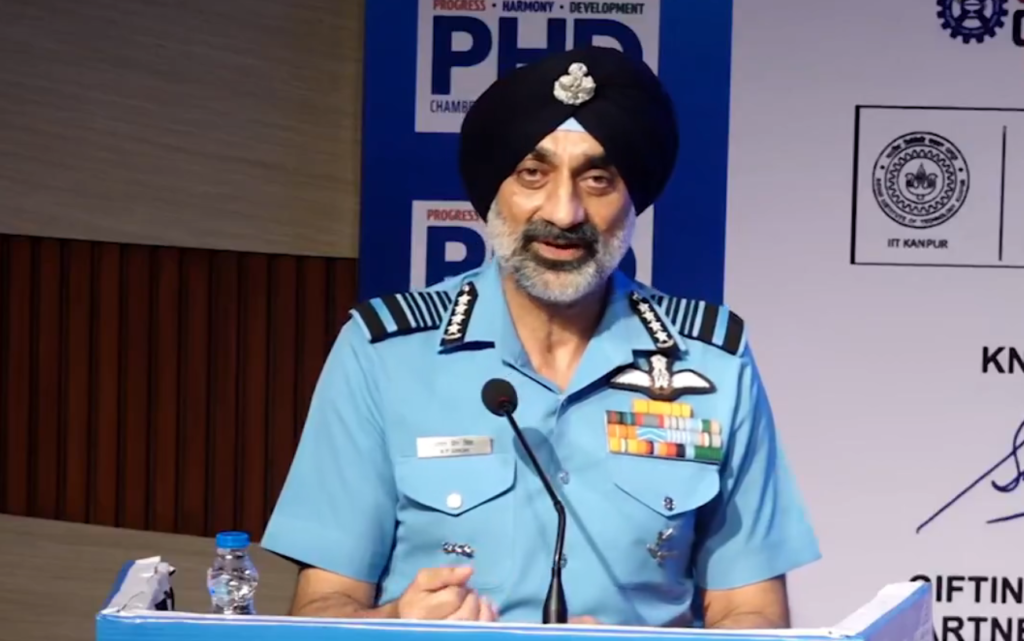
The future of aerial warfare is taking shape in India’s labs and innovation hubs, as the Indian Air Force (IAF) Chief, Air Chief Marshal Amar Preet Singh, pushes for a self-reliant drone ecosystem. Speaking at the Bharat Drone & Robotics Manthan 3.0 conference, he outlined critical steps for integrating domestic industry with military needs.
With unmanned systems becoming pivotal in modern warfare, Chief Marshal Singh highlighted the necessity for the IAF to keep pace with rapidly evolving technologies. He expressed that delays in technology adaptation could lead to operational setbacks, warning, “technology delayed is technology denied.”
During his address, Singh stated that users, particularly military personnel, must articulate operational requirements. He introduced the newly formed Directorate of Aerospace Design (DAD), designed as a conduit for startups and innovators. “The problem statement has to originate from us,” he emphasized, advocating for direct engagement with entrepreneurs seeking to understand the IAF’s needs for drones, sensors, and other equipment.
To enhance this engagement, the IAF plans to host Dronathon 2026 in September, encouraging firms to present live demonstrations instead of traditional paper-based evaluations. This innovative approach aims to stimulate rapid feedback and iterative development, essential in a field characterized by swift technological changes.
Addressing vulnerabilities surrounding foreign supply dependencies, Chief Marshal Singh made a strong case for domestic development. “Every brick should be developed in India. Then only we can say we are fully Atmanirbhar,” he stated, marking a clear mandate for Indian companies to step up in the aerospace sector.
The Air Chief cautioned against bureaucratic hurdles, advising a unified national strategy that includes academia, regulators, investors, and manufacturers. He noted, “If we want different results… let us do something different.” This call to action reflects the IAF’s commitment to fostering an environment where innovative solutions can swiftly transition from concept to execution.
Moreover, while drones are intended to complement existing manned platforms, Singh’s outreach represents a significant pivot towards collaborative endeavors. The emphasis rests on operational challenges transforming into opportunities for India’s dynamic aerospace startup scene.
Singh’s remarks resonate with the broader vision of achieving Atmanirbhar Bharat, reflecting a keen understanding of the importance of indigenization in defense manufacturing. By promoting a robust domestic drone ecosystem, the IAF hopes to bolster national security while paving the way for India’s aerospace industry to flourish.