

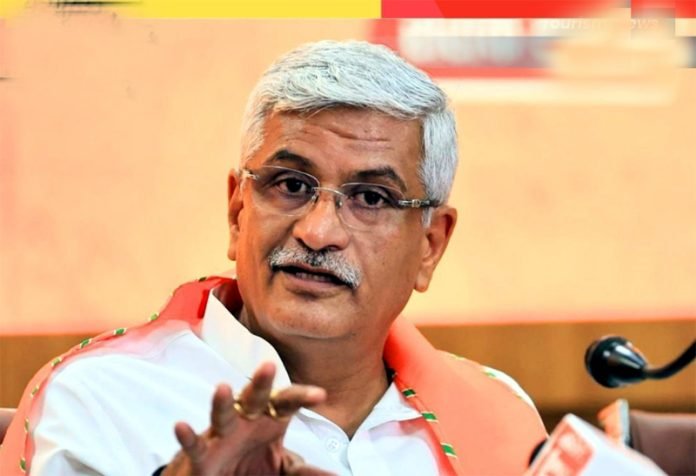
Union Culture Minister Gajendra Singh Shekhawat, during his address at the opening session of the South and West Asian Regional Branch of the International Council on Archives (SWARBICA) meeting, emphasized the deep cultural and historical ties between India and Bangladesh. His remarks come in the wake of recent reports about the defacement of murals of Sheikh Mujibur Rahman, the founder of Bangladesh, and the destruction of his historic residence in Dhaka.
Shekhawat reminded the audience that Bangladesh emerged as a nation after the Liberation War in 1971, a conflict in which India played a pivotal role. He highlighted that the people of Bangladesh had long acknowledged India’s significant contribution to their nation’s creation. “India and Bangladesh share cultural ties, similar histories, languages, and traditions,” he stated, stressing the long-standing cultural exchange between the two countries. Shekhawat pointed out that people in Bangladesh used to proudly accept India’s role in the creation of their nation.
The minister also referenced the broader cultural ties between India and other neighboring countries like Nepal, Bhutan, and Sri Lanka, underscoring that despite political differences, the region shares a deep cultural heritage. He noted that festivals, traditions, and common rivers have historically connected the countries of South Asia.
In light of the political unrest in Bangladesh, which saw unprecedented student-led protests last year, Shekhawat expressed concern over the destruction of Bangabandhu Sheikh Mujibur Rahman’s murals and his residence, a symbol of the nation’s founding. These actions, including the pulling down of Rahman’s statue and defacement of his murals, were linked to anti-government protests that targeted his legacy. His house, a historical site and memorial, was also severely damaged by the protesters.
The Union Minister pointed to the importance of digitizing and preserving shared historical records in the region, including the National Archives of India’s ambitious project to digitize 300 million pages over two years. This project, launched last year, aims to make crucial historical documents available online, benefiting not only researchers in India but also those in Bangladesh, Pakistan, and other countries in the region. Shekhawat emphasized that such a project would provide easy access to records of shared heritage and foster greater collaboration between nations.
Shekhawat also suggested that India could partner with neighboring countries like Nepal and Bangladesh to digitize records within their own nations, thereby strengthening regional cooperation. He underscored that the digitization of historical documents would preserve the region’s shared heritage, making it accessible to all countries, regardless of political or diplomatic differences.
“We were once one country, one geographical entity before independence,” Shekhawat said, reflecting on the shared heritage between India and Bangladesh. “Digitization offers a platform for preserving our shared history, and it will be just a click away for researchers in Bangladesh, Pakistan, Bhutan, Sri Lanka, and beyond,” he added.
In conclusion, Shekhawat called for the strengthening of cultural ties in the region, noting that despite political differences, the foundation for future cooperation would lie in culture and shared heritage.