


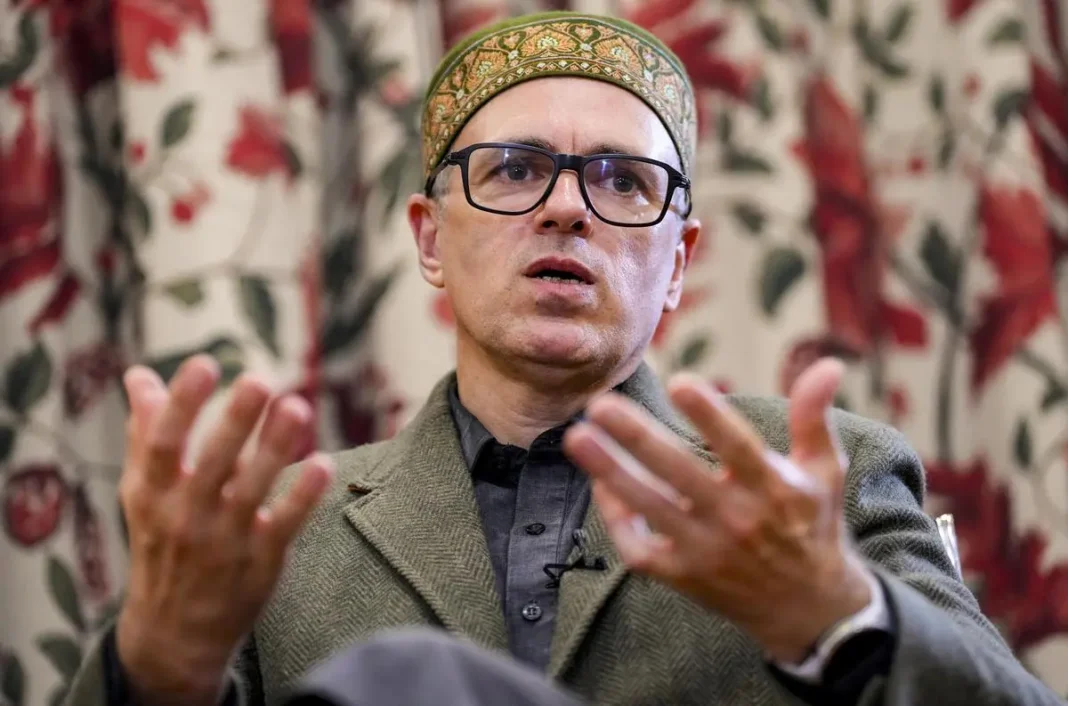
The Chief Minister of Jammu and Kashmir, Omar Abdullah, urged the Tamil Nadu Governor to provide an opportunity for TVK Chief Vijay to prove his majority in the assembly. Speaking on Friday, Abdullah argued that halting government formation at this stage lacks justification.
On Thursday, Tamil Nadu Governor Rajendra Vishwanath Arlekar declined Vijay’s request to form the government, citing insufficient numbers. The Tamilaga Vettri Kazhagam (TVK), currently devoid of a simple majority, faces challenges despite support from the Congress party, which has aligned with five MLAs. However, TVK still falls short of the necessary 118 seats in the 234-member assembly.
Abdullah voiced his concerns about the imposition of President’s rule in Tamil Nadu, referencing several Supreme Court judgments that mandate the inviting of the single largest party to form a government and subsequently prove its numbers in the assembly. According to Abdullah, such legal precedents negate the grounds for President’s rule.
“If we consider the Supreme Court’s ruling, then President’s rule lacks justification in Tamil Nadu. There are numerous cases where the SC has distinctly stated that after elections, the single largest party should be invited to govern and prove their majority,” Abdullah stated during a press conference, addressing the ongoing political uncertainty in Tamil Nadu.
He cited the historical example of former Prime Minister A B Vajpayee, who served for 13 days without an assurance of majority but was still invited to form the government. Abdullah emphasized that the President did not hesitate to allow Vajpayee to take charge before confirming the required support, leading to a resignation when numbers were insufficient.
“The Tamil Nadu Lok Bhavan has no basis for obstructing this process,” Abdullah asserted. He reiterated that Vijay should be given the chance to form the government and demonstrate his majority. “If he can prove his majority, he will govern; if not, he will resign,” Abdullah concluded, highlighting his confidence in democratic principles.