

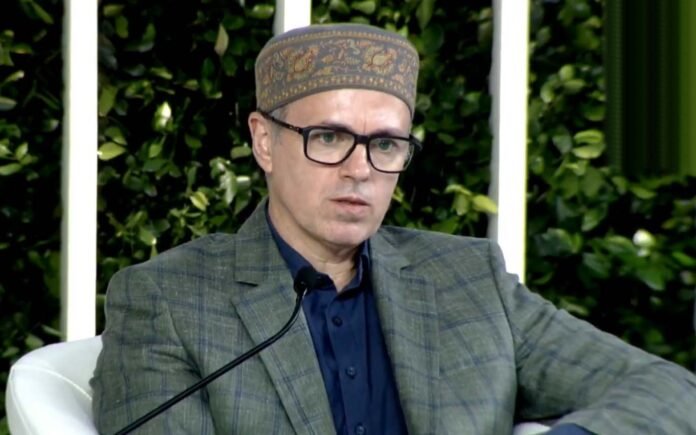
Jammu and Kashmir Chief Minister Omar Abdullah criticized his office’s role as one of “disempowerment” on Wednesday, claiming he has transitioned from leading an empowered state to overseeing a Union Territory with drastically reduced powers. This statement reflects Abdullah’s frustration during an event organized by a national newspaper, where he stressed the importance of restoring statehood for Jammu and Kashmir.
Abdullah voiced his concerns about the frequent interference from the Lieutenant Governor’s office, a situation he finds troubling. He stated, “It is incredibly difficult to reconcile the terms ‘Union Territory’ and ‘Jammu and Kashmir’ in the same sentence,” expressing disdain for the reduction in governance stature.
The Chief Minister recalled that while the term ‘State’ was once the norm, the current UT status is now emphasized constantly, leading to confusion and dissatisfaction among the populace.
Abdullah underscored his contention regarding an “asymmetrical” distribution of power, claiming that Lieutenant Governor Manoj Sinha continues to exercise control akin to an elected head of government. In particular, Abdullah criticized Sinha for chairing meetings that are traditionally the remit of an elected government, such as those related to the Jammu and Kashmir Power Development Corporation and tourism initiatives.
“What business does someone responsible for security have holding a tourism meeting?” Abdullah questioned, elaborating on the misalignment of powers. He also highlighted the improper appointment of an IAS officer to a position that should rightfully belong to a Jammu and Kashmir Administrative Services (JKAS) officer, citing this move as an attempt to undermine the elected government.
The Chief Minister further revealed that several cabinet decisions, including modifications to reservation percentages, remain unresolved, reinforcing his assertion of a power imbalance. “There is an asymmetrical allocation of power between the elected and unelected government,” he said, indicating deepening frustrations among the elected representatives.
On the issue of statehood restoration, Abdullah reminded the Centre of the three-step roadmap it had outlined, which includes delimitation, elections, and the re-establishment of statehood. He stated, “Two steps are complete. Why are we made to wait for the third?”
Abdullah challenged the central government to clarify what it means by “appropriate time” regarding statehood restoration. He criticized the government for appearing evasive. “If it is when the BJP comes to power, then be honest, so people can decide,” he said, implying political motivations behind the delay.
Addressing the controversial revocation of Article 370, Omar Abdullah emphasized that its restoration could only be realized after a shift in the central government, remarking, “It is pointless asking the people who took it away from us to give it back.” He stated his commitment to advocating for the special status while avoiding unrealistic promises to his constituents.
In a broader critique, Abdullah pointed out that rising hyper-nationalism and collective punitive measures threaten to radicalize discontented citizens. He condemned practices such as the demolition of houses after terror attacks, highlighting a specific incident where houses were demolished in response to a terror attack in Pahalgam, only for investigations to later reveal a lack of Kashmiri involvement. “If those people are radicalized, whose fault is it?” he urged, calling attention to the repercussions of such policies.
Furthermore, he raised concerns about radicalization connected to recent issues in sports and education where the predominance of successful Muslim candidates was met with backlash, stating, “When you push an entire community to the margins, how can you expect no reaction?” Abdullah’s ability to interpret and critique these socio-political dynamics underlines his engagement with community sentiments.
He also commented on the national political stage, describing the INDIA bloc as being in a precarious state, referring to it figuratively as being in the “ICU”. He acknowledged that pressing issues, such as Article 370, are not currently on the bloc’s agenda. Moreover, when discussing Congress leader Rahul Gandhi, he defended Gandhi’s silence regarding Article 370, adding, “I’d like him to win an election first before I can have this conversation.”
Breaking from his father’s stance, he rejected theories surrounding EVM tampering, insisting that the party should take responsibility for its electoral shortcomings, rather than attributing losses to external factors. He placed the blame on constituency delimitation, which he believes misrepresents their electoral reach.
Lastly, Abdullah addressed important issues related to the economy, environment, and tourism in Jammu and Kashmir. He pointed towards significant environmental challenges like pollution and prolonged dry spells affecting Srinagar, noting that the unique geography of the valley traps smog. He refuted the misconception that tourism is the primary economic driver, revealing that it ranked fourth in contributing to the Gross State Domestic Product, behind agriculture, horticulture, and industry.