

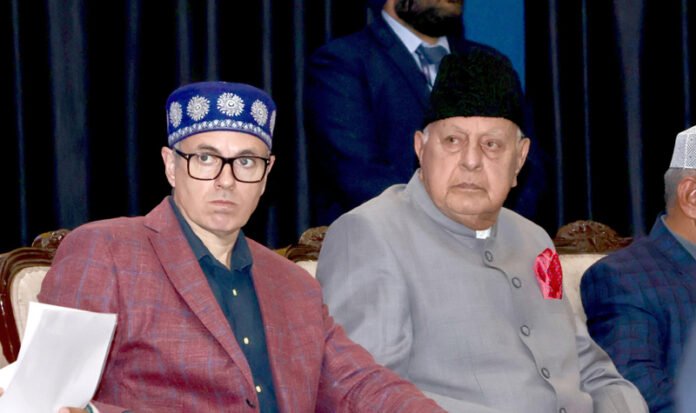
Former Chief Minister and National Conference president Dr. Farooq Abdullah stated today that Jammu is moving toward inclusive development under the leadership of Chief Minister Omar Abdullah. This development marks a departure from years of unfulfilled promises.
During a recent meeting with a delegation from the National Conference, Dr. Abdullah emphasized that this elected government has re-established public trust in democratic processes, ensuring that the corridors of power are now accessible to everyday citizens.
The delegation raised several pressing public issues that have lingered for over a decade, attributing them to what they described as the misadministration of the BJP. They praised the Omar Abdullah administration for initiating corrective and developmental measures aimed at reversing the setbacks Jammu faced.
“The Omar Abdullah-led government is making rapid strides to restore people’s faith in democratic institutions,” Dr. Abdullah said, underscoring the government’s commitment to comprehensive governance.
Dr. Abdullah also criticized the much-publicized Smart City project, stating that recent rain had exposed the overblown claims surrounding it. He pointed out that a few days of rain revealed rampant waterlogging, raising concerns about the project’s effectiveness.
Highlighting the current government’s initiatives, Dr. Farooq Abdullah mentioned the ongoing efforts to restore the historic Mubarak Mandi heritage complex. He acknowledged the importance of free transport for women, which has improved mobility, and noted that additional ration quotas provide relief to low-income families. Furthermore, he described the revival of the Darbar Move as a crucial move for economic activity, benefiting traders.
The National Conference president elaborated on ongoing projects, such as ropeways, riverside development, and lake creation in Jammu city, asserting that these initiatives aim to solidify Jammu’s position on the national tourism map.
In preparation for the upcoming Urban Local Body (ULB) and Panchayat elections, Dr. Abdullah urged party workers to enhance public outreach and ensure that governance reflects the aspirations of all citizens, especially the youth and women.
Meanwhile, Chief Minister Omar Abdullah recently addressed a gathering at the Gurjar Desh Charitable Trust (GDCT) in Jammu, highlighting the importance of scientific research on climate change impacts on the Gujjar-Bakerwal community. He argued that such studies would inform more effective future policies.
This address coincided with the third death anniversary of former Vice-Chancellor of Baba Ghulam Shah Badshah University, Dr. Masud Ahmed Choudhary, whom Omar Abdullah remembered as a visionary leader.
“There is an abundance of talent within Gujjar institutions,” King Abdullah noted. “If directed toward research on climate change, it will empower the community.” He emphasized that the nomadic lifestyle of the Gujjar-Bakerwal community renders them especially vulnerable to climate-related issues.
The Chief Minister also called for strengthening educational initiatives such as Gujjar hostels and mobile schools. He stressed the need for a serious assessment of the ramifications of reservation policies within the community. “We have discussed reservation extensively, but concrete studies on its real impacts are still not available,” he stated.
Dr. Farooq Abdullah echoed these sentiments, urging the community to unify and prioritize education, asserting that education is the key to securing a prosperous future for generations to come.
Prominent figures present at this gathering included several Ministers, MLAs, former Ministers, senior advocates, civil society members, and representatives of the Gujjar community, all of whom shared their insights on advancing community development and education.