


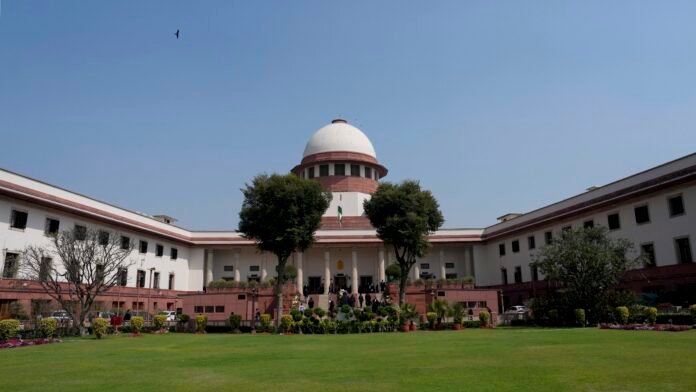
The Supreme Court has raised alarms about a concerning trend of judges passing numerous judicial orders just before their retirement. Chief Justice of India (CJI) Justice Surya Kant likened the practice to a batter “hitting sixes in the final overs” of a cricket match during a hearing on a suspension case involving a Principal District and Sessions Judge from Madhya Pradesh.
This observation came during a bench session that included Justices Joymalya Bagchi and Vipul M. Pancholi. The case involved the judge, suspended just 10 days before his scheduled retirement on November 30. His suspension stemmed from two controversial orders he issued prior to his retirement.
The CJI remarked, “It is an unfortunate trend. There is a growing tendency of judges passing so many orders just before retirement.” He further added, “Petitioner, just before retirement, started hitting sixes. I do not want to elaborate further.” Such comments brought attention to an issue that may undermine judicial integrity.
The suspended judicial officer challenged his suspension, arguing that he maintained an unblemished service record and regularly received high marks in his Annual Confidential Reports (ACRs). Senior advocate Vipin Sanghi, representing the judge, contended that a judicial officer could not face disciplinary action simply for issuing judicial orders.
“How can an officer be suspended for judicial orders which are appealable and can be corrected by higher courts?” Sanghi posed, emphasizing that disciplinary action in such contexts must be approached with caution.
In response, the Supreme Court acknowledged the principles at stake, stating that disciplinary hearings typically do not initiate due to judicial misunderstandings. However, the CJI queried, “But what if the orders are palpably dishonest?” He called attention to the fine line separating bona fide judicial decisions from misconduct.
Additionally, on November 20, the Supreme Court directed the Madhya Pradesh Government to extend the retirement age of judicial officers from 60 to 61 years. This decision meant that the suspended judge would now retire on November 30, 2026. The CJI noted that the officer was not aware of the retirement age’s extension when he issued the disputed orders.
The bench further probed why the officer had not approached the High Court to contest his suspension. Sanghi explained that since the suspension resulted from a Full Court decision, the judge believed it prudent to appeal directly to the Supreme Court.
The Bench acknowledged that High Courts have nullified Full Court decisions in numerous judicial proceedings previously, indicating a potential avenue for the judge.
Moreover, the Court expressed its disapproval regarding the officer’s decision to seek information about his suspension via the Right to Information (RTI) Act. The Bench stated, “It is not expected of a senior judicial officer to resort to the RTI route. He could have submitted a representation.” Such remarks accentuate the expectation of decorum within judicial ranks.
In the end, the Supreme Court declined to entertain the petition but granted the officer the liberty to file a representation before the Madhya Pradesh High Court, aiming for a reconsideration of his suspension. The Bench instructed the High Court to address the representation within four weeks.