

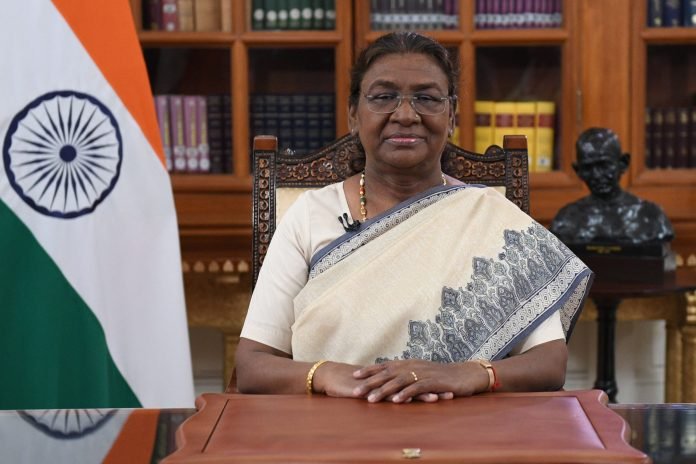
New Delhi, Dec 10 – President Droupadi Murmu on Tuesday emphasized that the rise of artificial intelligence (AI) and other emerging challenges are reshaping the human rights discourse, pointing out that the “culprit” in violations could no longer be assumed to be human but could be an intelligent, non-human agent.
Speaking at an event hosted by the National Human Rights Commission (NHRC) in New Delhi to mark Human Rights Day, President Murmu highlighted that cyber crimes and climate change are now significant new threats to human rights.
Human Rights Day, observed on December 10 each year, commemorates the Universal Declaration of Human Rights (UDHR), adopted by the United Nations General Assembly in 1948. The UDHR remains a cornerstone in the global effort to protect and promote human rights.
Emerging Threats to Human Rights
“As we progress into the future, we are confronted with emerging challenges. Cyber crimes and climate change are new threats to human rights,” President Murmu said in her address.
She noted that while the digital age has brought about transformative benefits, it has also introduced complex issues like cyberbullying, the proliferation of deepfakes, privacy violations, and the spread of misinformation. These issues, she said, underline the need for a “safe, secure, and equitable digital environment” that upholds the rights and dignity of every individual.
AI and the New Paradigm of Human Rights Violations
Turning to the subject of AI, President Murmu highlighted the dual nature of its impact. While AI has been instrumental in solving many problems, it has also given rise to new challenges, particularly in the realm of human rights.
“The human rights discourse so far has been centred on human agency, with the violator typically being assumed to be a human who could possess emotions like compassion and guilt,” she explained. “However, with AI, the culprit could be a non-human intelligent agent. I leave the matter for you to ponder over,” she added, urging the audience to reflect on this evolving issue.
Climate Change and Global Human Rights Thinking
President Murmu also touched on the global implications of climate change, suggesting that it forces a re-evaluation of human rights thinking on an international level. As the impact of environmental degradation intensifies, it increasingly challenges existing frameworks for human rights protection, particularly in vulnerable communities.